
Governed Workflow
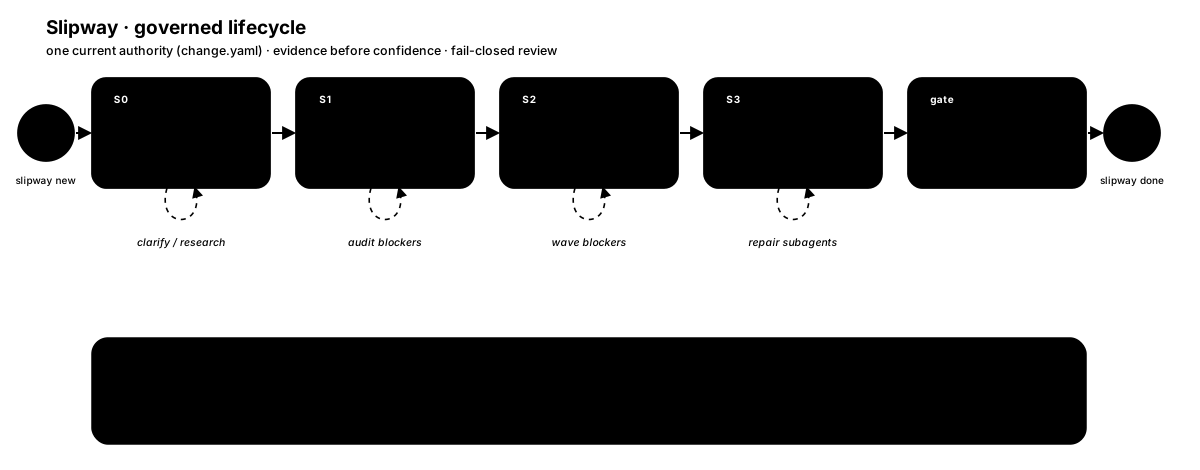
Slipway routes work through a governed lifecycle:
S0_INTAKE: capture intent, scope, open questions, and initial evidence.S1_PLAN: produce research, requirements, decision, task, and plan-audit artifacts. Plan-audit is the review that permits S2 to start; it reviews the plan bundle itself, not a frozen wave cache.S2_IMPLEMENT: execute computed waves. Slipway computes the wave schedule live from each task’s declared dependencies and target files in the currenttasks.md; authors never declare wave numbers. Dependency-free, file-disjoint tasks share a wave and are dispatched concurrently by default —slipway next --jsonmarks such a waveparallel: true. Setexecution.parallelization: offin.slipway.yamlto run waves sequentially instead.S3_REVIEW: verify implementation against artifacts, run selected review checks, repair feedback through separate subagents, then run the single terminalship-verificationgate (one authoritative full suite, acceptance proof, freshness recheck, theassurance.mdattestation, and reviewer-independence attestation) to produce a done-ready outcome.
The active lifecycle state is stored in artifacts/changes/<slug>/change.yaml.
Bundle-local lifecycle events stay under
artifacts/changes/<slug>/events/, and skill verification records stay under
artifacts/changes/<slug>/verification/. Runtime task evidence recorded during
wave execution lives under
.git/slipway/runtime/changes/<slug>/evidence/....
Create A Change
Section titled “Create A Change”slipway new "refresh governance docs" --preset standardJSON stdin lets AI callers provide classification directly:
echo '{"guardrail_domain":"","needs_discovery":true,"complexity":"complex","test_cmd":"go test ./...","build_cmd":"go build ./...","languages":["Go","Markdown"]}' \ | slipway new --json "refresh governance docs"When classification is omitted, Slipway uses conservative defaults:
guardrail_domain=""needs_discovery=truecomplexity="complex"
Progression Styles
Section titled “Progression Styles”Use next for explicit handoff control:
slipway next --json# complete the surfaced skill or resolve blockersslipway run --jsonslipway next --jsonUse run when you want Slipway to advance until an operator-facing stop:
slipway run --json --diagnosticsrun stops on a surfaced skill, blocker, or done-ready outcome.
Independence Attestation Tokens
Section titled “Independence Attestation Tokens”The review, ship-verification, and wave-orchestration stages record a few
engine-consumed tokens on the verification record’s references (via
slipway evidence skill --reference ...). Each is an error-severity blocker on
standard/strict and advisory-only on light (realized as Pattern-A omission —
the gate simply returns no blocker on light, there is no separate advisory
channel in this seam). No token lets a stage self-certify freshness or a final
verdict; the engine remains the sole timestamp and run-version
stamper.
| Token | Attests | Enforced | Recovery when the gate fails closed |
|---|---|---|---|
context_origin:stage=<stage>=<handle> across the chain participants, with selected S3 reviewers all using stage=review and review-finding fixes using stage=fix when present |
each owned participant ran under distinct contexts on the shared worktree; selected reviewers are keyed by skill name and must be pairwise distinct; recorded fix handles must not collapse with implementation or review handles | standard/strict error, light advisory | re-run the owning reviewer or fix through its configured fresh delegated session so it re-emits a distinct context_origin handle |
closeout:reviewer_independence=pass on ship-verification |
the reviewer-independence attestation is present on the terminal ship record (Pattern-A); missing fails closed with ship_verification_reviewer_independence_missing |
standard/strict error, light advisory | re-run ship-verification and record the token |
closeout:assurance_complete=pass on ship-verification |
the host attests assurance.md is complete on the terminal ship record; missing fails closed with ship_verification_assurance_attestation_missing |
standard/strict error, light advisory | re-run ship-verification and record the token |
terminal ordering ship-verification >= every selected S3 peer (always-on, no token) |
the terminal ship record was stamped after every selected S3 review peer rather than before any of them, so the gate observed the final review evidence | every preset (always-on; no light carveout) | re-stamp the stale selected reviewer, then re-run ship-verification so its verdict timestamp is at or after every peer |
degraded_dispatch_justification:wave=<n>:tool_unavailable=<detail> on wave-orchestration |
a degraded_sequential dispatch was paired with a genuine tool-unavailable justification |
standard/strict error, light advisory | re-record wave-orchestration evidence with the justification reference, or re-run the wave with real concurrent dispatch |
A bare degraded_sequential with no paired justification is rejected on every
path that synchronizes governed wave execution, including the
slipway evidence skill path — not only advance/next.
context_origin:stage=<stage>=<handle> is one chain-wide grammar that spans the
whole governed chain. The S3 selected review set includes spec and independent
reviewers for every workflow profile; code-quality review joins when the profile
requires code-quality review, and security review joins when the engine-derived
security control selects it. The terminal ship-verification gate is not a
selected peer — it runs last, after the peers converge. All selected review hosts emit
context_origin:stage=review=<handle>; the R2 lattice keys each review
participant by skill name, not by the shared review stage. The other
participants are the S2 wave executor, the S1 plan-audit audit_origin (paired
against the plan’s plan_origin author), and optional S3 review-finding fix
handles recorded on reviewer evidence. The collision lattice is owned per seam,
so each edge is checked exactly once:
| Seam | Owns | Edges |
|---|---|---|
| Plan gate (S1) | only the local audit_origin != plan_origin edge (plan-audit author vs auditor self-audit) |
1 |
| Review authority | every edge among {executor, fix} plus the selected review-skill keys; S1 audit_origin is not a live S3 participant |
variable by workflow profile, selected security control, and optional fix handle |
| Ship authority | no additional context-origin edges; the terminal ship-verification gate owns the terminal ordering invariant plus the reviewer-independence and assurance-complete presence attestations |
0 |
When a seam fails closed, re-run its owning stage or selected reviewer through
the configured fresh delegated session, defaulting to native host dispatch, so
the stage re-emits a distinct context_origin handle; the engine remains the
sole verdict stamper and never restamps the collapsed handle.
The context_origin lattice is audit/structural tier: the handles are
host-emitted strings — the same structural tier as the executor-dispatch
handles — so it raises the cost and auditability of collapsing chain stages into
one authoring context but is never cryptographic proof of independence. Genuine
non-forgeable distinct-context discrimination (an engine-issued per-stage nonce or
lifecycle-event boundary, “Option B”) is infeasible within this change’s
constraints, so no gate here is overstated as cryptographic distinct-context proof.
S3 Review Dispatch
Section titled “S3 Review Dispatch”At S3_REVIEW the engine resolves one selected review set and exposes that set
through the command surfaces. Spec and independent review are selected for every
workflow profile; code-quality review joins only when the profile requires
code-quality review, and the security reviewer joins only when the engine-derived
security control is selected. slipway next exposes the selected set, and host
adapters fan those reviewers out using the configured review slot, defaulting
to concurrent native subagents when no slot is configured. Any conventional
single primary skill is only a compatibility projection for surfaces that truly
need one; it does not imply review ordering. The terminal ship-verification
gate is dispatched after this peer set converges, never as a member of it.
Selected reviewers are unordered peers: none blocks another, and requiredness,
review authority, ship authority, and stale-evidence recovery all consume the
same selected set. Every selected reviewer records
context_origin:stage=review=<handle> with its own distinct handle. The R2
lattice compares those handles under skill-name participant keys, so duplicate
reviewer handles fail closed even though the wire token’s stage label is shared.
When a review finding is repaired through slipway fix, the affected reviewer
also records context_origin:stage=fix=<repair-handle> on rereview; any recorded
fix handle participates in the same distinct-context lattice.
Missing selected reviewer evidence is owned by required-skill blockers; a passing
selected review record with no well-formed stage=review handle fails closed
with context_origin_handle_invalid; collisions fail with
cross_stage_context_not_distinct. Unselected security evidence on disk is
silent and never becomes a hidden participant.
Selected reviewer freshness is anchored by the current diff, planning artifacts,
and run_summary_version; there is no shared suite-result keystone for the peer
set to consume. The one authoritative full suite — and any guardrail SAST
baseline — is run by the terminal ship-verification gate, once, after the
peers converge, and recorded on its own evidence record rather than a record
shared with the reviewers.
Read-Only Surfaces
Section titled “Read-Only Surfaces”These commands inspect state without mutating lifecycle authority:
slipway nextslipway statusslipway validate
Use validate directly for its machine-readable JSON report. Use --json on
read-only commands that still expose text by default, such as next and
status. Use --diagnostics on next or run when you need gate details,
artifact readiness, or transition traces.
Open Questions Semantics
Section titled “Open Questions Semantics”intent.md may contain a canonical ## Open Questions section. The engine gates
on structure, not prose: only an unchecked checklist item blocks intake.
These read as resolved (intake advances to S0_INTAKE/confirm):
## Open Questions(none)## Open Questions- None requiring research — the page model is already specified.## Open Questions- [x] Installer path resolved by research.Only an unchecked - [ ] entry blocks (routes to S0_INTAKE/research):
## Open Questions- [ ] Which installer path should be documented?Free-form prose and bare bullets are documentation, never a blocker. Deciding
whether something is a genuine open question is a semantic judgment owned by the
intake-clarification skill, which records a real unknown as a - [ ] item; the
engine never parses intent prose. This keeps a no-unknowns change (None, a
sentinel sentence, or an empty section) from silently detouring into research,
while letting an artifact preserve question history with - [x]. When an entry
does block, slipway run names the specific - [ ] line so the routing is not
silent.
When the governed state is done-ready:
slipway donedone finalizes the active change and archives terminal state. If local state looks inconsistent after interruption, inspect first with slipway health --doctor, then run slipway repair if the suggested repairs match the issue.