
Machine protocol v2 tutorial
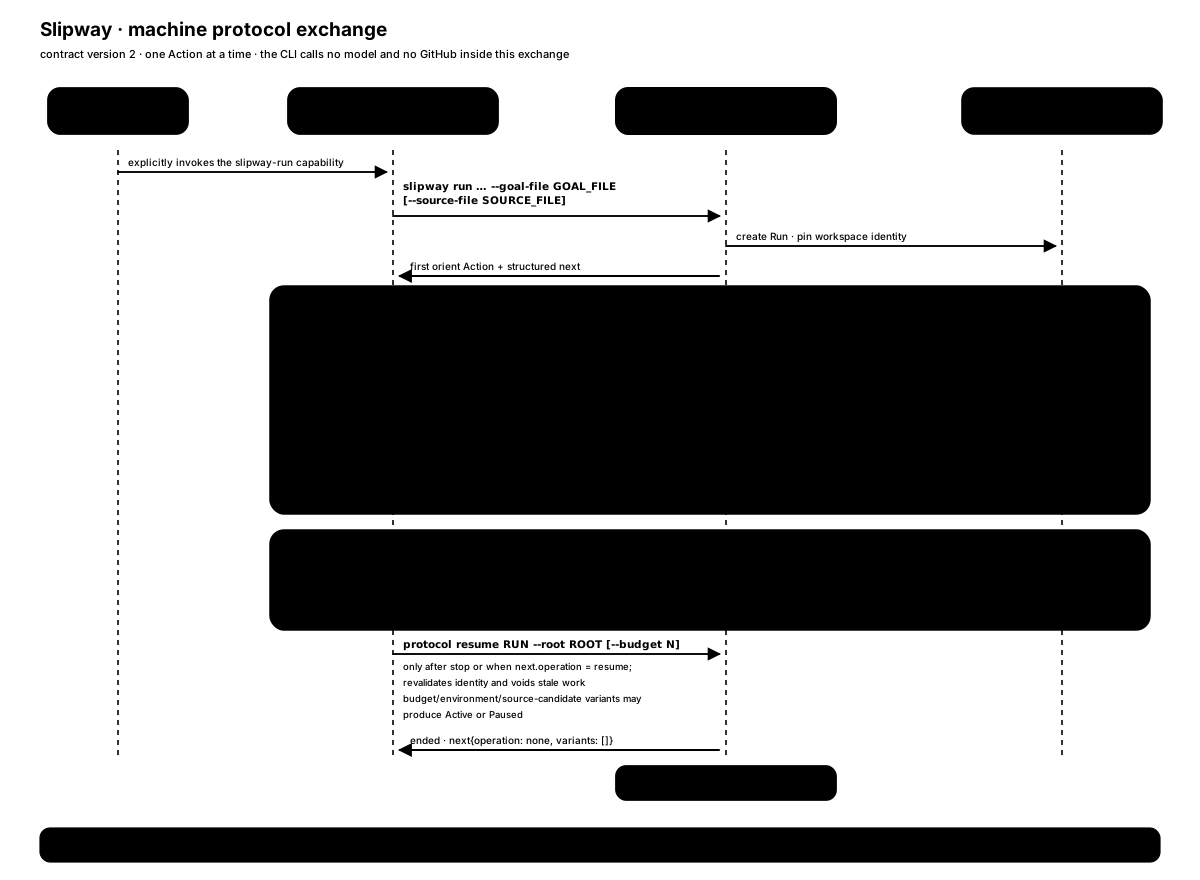
This tutorial runs one complete local protocol lifecycle: start a Run, submit Orient and Implement outcomes, and end with Summarize. It is intended for host and adapter authors. Generated host capabilities normally perform these protocol operations; they are not an alternative end-user workflow.
The canonical contracts are the versioned machine protocol schema and source envelope schema. Keep the version in the URL and the JSON contract_version or source_version together; unversioned compatibility aliases are intentionally not published.
Prerequisites
Section titled “Prerequisites”Install slipway, git, and jq. Run every snippet in the same shell session. The tutorial works inside a disposable directory because it creates a real Run journal and changes a tracked file.
TUTORIAL_DIR=$(mktemp -d)WORKSPACE="$TUTORIAL_DIR/workspace"mkdir -p "$WORKSPACE"cd "$TUTORIAL_DIR"git -C "$WORKSPACE" init -qgit -C "$WORKSPACE" config user.name 'Protocol Tutorial'git -C "$WORKSPACE" config user.email tutorial@example.invalidprintf '# Protocol tutorial\n' > "$WORKSPACE/README.md"git -C "$WORKSPACE" add README.mdgit -C "$WORKSPACE" commit -qm initial1. Start the Run
Section titled “1. Start the Run”Pass flags before the -- separator and keep the goal as one literal argument. --no-review makes this short lifecycle proceed directly from Implement to Summarize.
slipway run \  --budget 4 \  --json \  --root "$WORKSPACE" \  --no-review \  -- "add one tutorial line to README.md" > start.json
jq -e '  .contract_version == 2 and  .state == "active" and  .action.kind == "orient" and  .next.operation == "action"' start.json
RUN_ID=$(jq -r '.run_id' start.json)ORIENT_ID=$(jq -r '.action.action_id' start.json)
A production host should validate the complete response against the machine protocol schema. The jq expression only makes the important tutorial assertions visible. Preserve next.variants[].base_argv as an argument array; never parse a rendered command string.
2. Submit the Orient outcome
Section titled “2. Submit the Orient outcome”Every public Outcome field is present. Branches that do not apply are JSON null, and empty collections remain arrays.
jq -n --arg action "$ORIENT_ID" '{  contract_version: 2,  action_id: $action,  action_kind: "orient",  status: "completed",  summary: "Repository facts observed.",  observations: ["README.md is the only tracked file."],  known_issues: [],  suggested_actions: [{    kind: "implement",    brief: "Append the requested tutorial line."  }],  pause: null,  implementation: null,  review: null}' > orient-outcome.json
slipway protocol submit \  --run "$RUN_ID" \  --action "$ORIENT_ID" \  --root "$WORKSPACE" \  --outcome-file orient-outcome.json > implement.json
jq -e '.contract_version == 2 and .action.kind == "implement"' implement.jsonIMPLEMENT_ID=$(jq -r '.action.action_id' implement.json)
The action_id and action_kind must match the outstanding Action. A host must not copy an ID from an earlier response or invent the next Action.
3. Perform and report implementation
Section titled “3. Perform and report implementation”Make the observable change, run a check, and report the exact activity and exit code.
printf 'Protocol v2 lifecycle completed.\n' >> "$WORKSPACE/README.md"git -C "$WORKSPACE" diff --check
jq -n --arg action "$IMPLEMENT_ID" \  --arg check_command "git -C \"$WORKSPACE\" diff --check" '{  contract_version: 2,  action_id: $action,  action_kind: "implement",  status: "completed",  summary: "Appended the requested README line.",  observations: [],  known_issues: [],  suggested_actions: [],  pause: null,  implementation: {    result: "applied",    files_changed: ["README.md"],    activities: [{      kind: "test",      command: $check_command,      exit_code: 0,      summary: "No whitespace errors."    }],    uncertainties: [],    attempts: 1  },  review: null}' > implement-outcome.json
slipway protocol submit \  --run "$RUN_ID" \  --action "$IMPLEMENT_ID" \  --root "$WORKSPACE" \  --outcome-file implement-outcome.json > summarize.json
jq -e '.action.kind == "summarize"' summarize.jsonSUMMARIZE_ID=$(jq -r '.action.action_id' summarize.json)
files_changed is a host report, not proof of attribution. Slipway separately records bounded Git observations and preserves uncertainty about concurrent user or tool changes.
4. End the Run
Section titled “4. End the Run”jq -n --arg action "$SUMMARIZE_ID" '{ contract_version: 2, action_id: $action, action_kind: "summarize", status: "completed", summary: "The requested README update is complete and git diff --check passed.", observations: [], known_issues: [], suggested_actions: [], pause: null, implementation: null, review: null}' > summarize-outcome.json
slipway protocol submit \ --run "$RUN_ID" \ --action "$SUMMARIZE_ID" \ --root "$WORKSPACE" \ --outcome-file summarize-outcome.json > ended.json
jq -e ' .contract_version == 2 and .state == "ended" and .next.operation == "none" and (.next.variants | length) == 0' ended.json
rm -rf "$TUTORIAL_DIR"Submitting the exact same Outcome bytes again is idempotent. Different bytes for the same completed Action fail with outcome_conflict; a stale Action ID fails closed. Branch on the structured error code, not message text.
Issue-backed extension
Section titled “Issue-backed extension”For an issue-backed Run, the trusted host first validates and writes a private temporary source envelope, then passes it once with --source-file. The response adds pinned_source, action.source, action.requirements, and a structured protocol material reader. Fetch only manifest-referenced comments and never treat discussion comments as requirements. See the machine protocol reference and ADR-0001 for the authority and publication model.