Host adapters
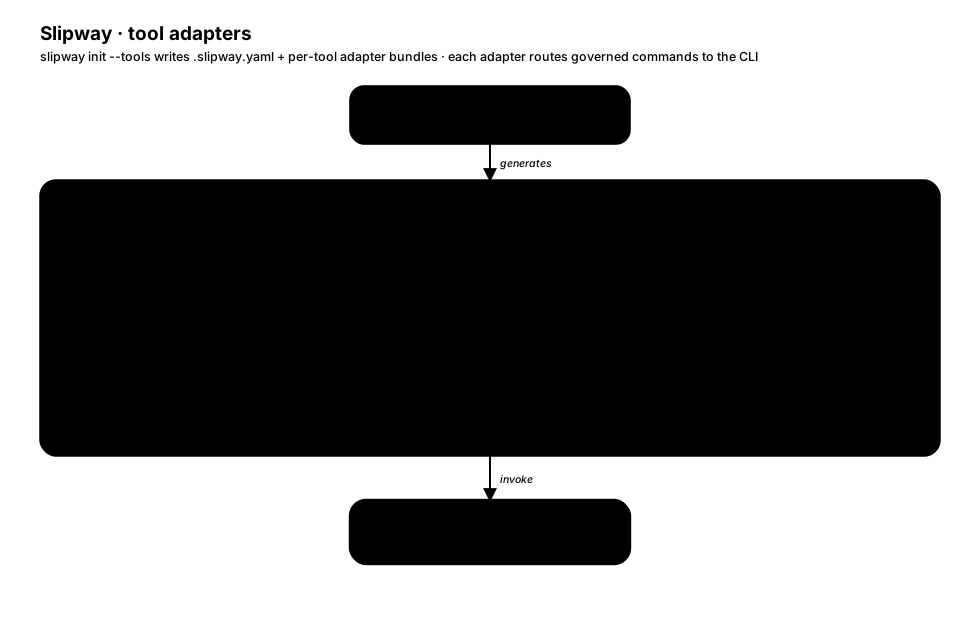
slipway install generates host-native entry points for seven explicit capabilities:
slipway-run slipway-clarify slipway-propose slipway-decomposeslipway-implement slipway-review slipway-workflowrun drives a recoverable Run. clarify is a standalone, stateless decision conversation. propose and decompose prepare GitHub work items. implement performs technical work. review is read-only. workflow coordinates those Issue-workflow functions: from a rough idea, Objective, Change, or existing Run it names the shortest valid next explicit capability without invoking it, or reports an explicit no-further-action outcome.
Generated targets
Section titled “Generated targets”The table describes generated files and intended invocation. External host behavior depends on the installed host version; repository tests validate generation and protocol text, not every host’s runtime UI.
| ID | Generated target | Intended invocation |
|---|---|---|
claude |
.claude/skills/slipway-*/SKILL.md |
Invoke the slipway-<name> skill. |
codex |
.codex/skills/slipway-*/SKILL.md plus per-skill agents/openai.yaml |
$slipway-<name> |
copilot |
.github/agents/slipway-<name>.agent.md |
Select the custom agent. |
cursor |
.cursor/skills/slipway-*/SKILL.md |
Invoke the slipway-<name> skill. |
kilo |
.kilo/commands/slipway-<name>.md plus .kilocode/slipway/capabilities/ |
/slipway-<name> |
kiro IDE |
.kiro/steering/slipway-<name>.md plus .kiro/slipway/capabilities/ |
Manually include #slipway-<name>. |
kiro CLI |
.kiro/agents/slipway-<name>.json plus .kiro/slipway/capabilities/ |
kiro-cli chat --agent slipway-<name> |
opencode |
.opencode/commands/slipway-<name>.md plus .opencode/slipway/capabilities/ |
/slipway-<name> |
pi |
.pi/skills/slipway-*/SKILL.md |
/skill:slipway-<name> |
qwen |
.qwen/skills/slipway-*/SKILL.md |
Invoke the slipway-<name> skill. |
windsurf |
.windsurf/workflows/slipway-<name>.md plus .windsurf/slipway/capabilities/ |
/slipway-<name> |
Copilot agents are self-contained. Kilo, Kiro, OpenCode, and Windsurf use a thin native entry that points to a generated capability body. Skill-native hosts receive the capability body in SKILL.md.
Kiro needs --surface ide or --surface cli on first install. The choice is recorded and cannot be switched by an ordinary refresh.
Explicit invocation
Section titled “Explicit invocation”Adapters do not install session-start hooks, prompt-submit hooks, launchers, or a global router. Host settings remain outside adapter ownership. A user explicitly invokes a capability; within an explicitly started slipway-run, the host may then follow the bounded Action loop without asking for authorization before every ordinary step.
Codex policy files disable implicit model invocation for each generated capability. Other targets use their native explicit-entry surface and shared instructions.
CLI and host responsibilities
Section titled “CLI and host responsibilities”The CLI:
- validates and records Runs;
- chooses the next Action;
- observes Git and workspace identity;
- validates source envelopes and Outcomes;
- returns structured recovery.
The host:
- reads repository files and performs technical work;
- calls the model;
- uses GitHub credentials when the user requests issue-backed work;
- constructs temporary source envelopes;
- follows publication previews, confirmations, and reconciliation instructions.
Accordingly, propose and decompose describe how the host should use GitHub APIs; the Go CLI does not provide a GitHub publication transaction. See Using GitHub Issues.
Install and refresh
Section titled “Install and refresh”slipway install --tool claudeslipway install --tool kiro --surface ideslipway listslipway doctorslipway install --tool claude --refreshslipway uninstall --tool claudeSee Installation for the first-time Kiro and --tool all caveat.
Ownership safety
Section titled “Ownership safety”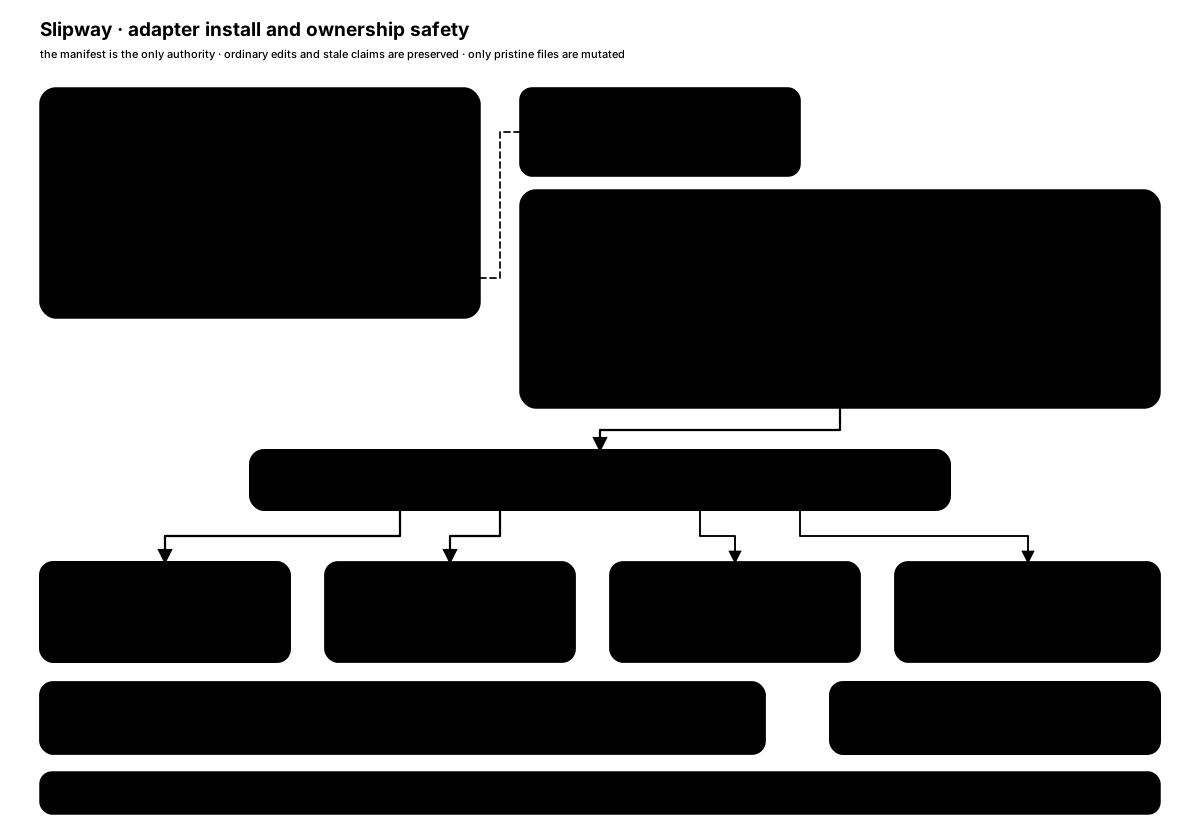
Each host root contains a Slipway ownership manifest with repository-relative paths and SHA-256 hashes. Refresh and uninstall mutate only files still matching their recorded hash.
An ordinary user-modified capability has current bytes that differ from its recorded claim and are not generated by this version; it is preserved and reported, never overwritten or removed. A stale generated claim is different: the recorded hash does not match bytes generated by the current version. The file is still preserved and is not overwritten or removed, the stale claim is withdrawn, and manual removal is needed before slipway install --refresh can regenerate it.
Unknown files, a modified sentinel, a malformed manifest, a path escape, a duplicate claim, or an unsafe symlink are never silently adopted as managed content. Operations preserve or reject them and report the reason. Transaction recovery artifacts are reported separately from ordinary preserved user files.
A generated sentinel indicates installation health, not ownership. The manifest is the only file that authorizes later managed-file changes, and unsupported manifest versions fail before mutation.